Our foam mattress factory in Vietnam had always operated in two disconnected worlds. On one side, we purchased pre-made polyurethane foam buns from suppliers — large cylindrical blocks produced at an industrial plant 300 kilometers away. On the other side, our cutting department sliced those buns into mattress layers using vertical and horizontal cutting machines. The handoff between these worlds was expensive, slow, and plagued by quality inconsistency.
The solution was to connect them. We installed the IF-FF4 Horizontal Continuous Foaming Plant to produce our own polyurethane foam buns in-house, and paired it with the IF-FYQ1 Foam Peeling Machine to convert those buns into continuous precision-thickness foam layers. The result is a fully integrated foam production line that takes raw chemicals at one end and delivers finished foam mattress layers at the other — cutting our foam costs by 55%, eliminating supply chain dependencies, and giving us complete control over foam density, thickness, and quality.
Our factory produces approximately 1,500 foam mattresses per month, each requiring multiple layers of polyurethane foam in different densities and thicknesses. Before we integrated foam production, every single foam bun — cylindrical blocks roughly 2m long and 1.2m in diameter — came from an external supplier. Each bun cost approximately $480 delivered, and we consumed 35 to 40 buns per month. That is $16,800 to $19,200 per month in bun costs alone.
The supply chain was a constant headache. The supplier operated on a minimum 10-day lead time, and their production schedule dictated our production schedule — not the other way around. When we needed a different density for a custom order, the minimum order was six buns (even if we needed only one), and the lead time extended to 18 days. Rush orders carried a 25% surcharge.
Quality was perhaps the most frustrating variable. Foam density varied by up to 12% between buns from the same supplier batch. Since the bun is produced continuously and then cut into sections, one end of a foam bun could have a different density profile than the other end, depending on how the chemical mixing and conveyor speed were calibrated during that production run. This inconsistency meant we had to test every bun upon arrival and often had to reject entire buns when density fell outside our acceptable range of 25–30 kg/m³.
The peeling stage added another layer of inefficiency. Pre-made foam buns arrived at our factory as solid cylinders. To turn them into mattress layers, they first had to be peeled — a process that involves rotating the bun against a long horizontal blade to peel off continuous foam sheets of precise thickness. We were outsourcing this peeling work to a local contractor at $3.50 per bun, adding another $126 to $140 per month in handling costs and introducing a 3-day delay into our production schedule.
After tracking these costs for six months, I calculated that our total monthly foam expenditure — buns, peeling, shipping, rejects, and rush surcharges — averaged $22,500. We were spending over a quarter of a million dollars annually on a material we had no control over producing. It was time to bring both foaming and peeling in-house.
We chose the IF-FF4 Horizontal Automatic Continuous Foaming Plant as our primary foam production unit. Unlike the IF-FF3 box foaming machine we previously used for smaller batch production, the IF-FF4 is designed for truly continuous operation — producing a steady, uninterrupted flow of polyurethane foam bun that can run 24 hours a day.
The IF-FF4 works by continuously mixing polyol, isocyanate, and additives in precisely controlled ratios and depositing the mixture onto a moving conveyor system. As the chemical reaction occurs, the foam rises and cures in a continuous bun shape. The result is a foam bun of virtually unlimited length — we can produce buns as long as the raw material supply allows. Our typical production run lasts 8 hours and produces a bun approximately 60 meters long, which we then cut into 2-meter sections for handling and storage.
The key advantage of the IF-FF4 over batch foaming is density consistency. Because the chemical mixing is continuous and computer-controlled, the foam density varies by less than 3% across the entire bun length. Compare this to the 12% variation we experienced from suppliers. The IF-FF4 also allows us to change formulations on the fly — we start a run with 25 kg/m³ foam for comfort layers, gradually transition to 35 kg/m³ for support layers, and finish with 45 kg/m³ for high-density applications — all in a single continuous bun. This capability was simply not available from our external suppliers.
The IF-FF4 produces foam suitable for an extraordinary range of applications — furniture, bedding, packaging, automotive, and even specialized foams for construction and aviation. For our mattress factory, it covers every density we need and opens the door to custom formulation development that was impossible when we relied on external suppliers.
| Operation Type | Continuous horizontal foaming |
| Bun Dimensions | Up to 2m wide × 1.2m high, unlimited length |
| Density Range | 8 – 80 kg/m³ |
| Density Consistency | ±3% across bun length |
| Formulation Change | On-the-fly during production |
| Applications | Mattress, furniture, automotive, packaging, construction |

The IF-FF4 Continuous Foaming Plant — producing unlimited-length foam buns with precise density control.
Producing foam buns in-house solved the supply and cost problem, but we still needed to convert those buns into the thin, consistent layers required for mattress construction. That is where the IF-FYQ1 Foam Peeling Machine became an essential partner to the IF-FF4.
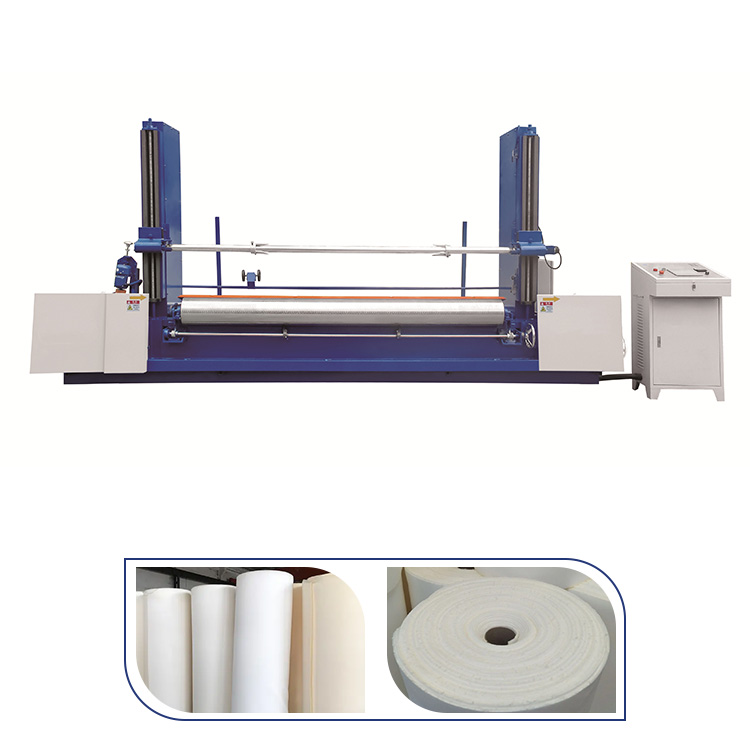
The IF-FYQ1 is designed specifically for peeling round (cylindrical) foam buns into continuous thin sheets. The bun is mounted on a rotating spindle, and a long horizontal blade peels foam from the outer surface in a continuous spiral — much like unwinding a roll of paper, but with foam. The result is a single, uninterrupted sheet of foam that can be up to 60 meters long and as thin as 2mm, depending on the bun size and the material being peeled.
We operate the IF-FYQ1 in a straightforward workflow. A 2-meter foam bun section from the IF-FF4 is loaded onto the peeling machine's spindle. The operator sets the desired layer thickness on the digital control panel — typically 10mm for standard comfort layers, 5mm for thin lamination sheets, or 20mm for support layers. The machine rotates the bun against the peeling blade and produces a continuous foam sheet of exactly that thickness, rolled onto a take-up roller at the output end.
The precision of the IF-FYQ1 is one of its most valuable attributes. The peeling blade maintains thickness accuracy within ±0.3mm across the entire length of the sheet. This level of precision is critical for mattress comfort layers, where even a 1mm variation in foam thickness can create a noticeable difference in sleeping surface feel. Our manual cutting processes could not achieve better than ±2mm, and even our outsourced peeling contractor averaged ±1mm. The IF-FYQ1's ±0.3mm consistency has virtually eliminated thickness-related comfort complaints from our customers.
| Peeling Thickness | 2mm – 50mm+ |
| Thickness Accuracy | ±0.3mm |
| Bun Compatibility | Round/cylindrical buns from IF-FF4 |
| Output Format | Continuous sheet on take-up roller |
| Max Sheet Length | Up to 60m per bun (2m section) |
| Applications | Mattress layers, lamination sheets, packaging foam |
The real power of the IF-FF4 and IF-FYQ1 combination is how seamlessly the two machines integrate into a single production flow. Here is how our end-to-end foam production line operates:
Stage 1 — Raw material preparation: Polyol, isocyanate, and additives are stored in temperature-controlled tanks adjacent to the IF-FF4. Our lead chemist formulates the chemical recipe based on the target foam density. For a standard run, we prepare enough chemicals for 8 hours of continuous production — approximately 1,200 kg of formulated mixture.
Stage 2 — Continuous foaming (IF-FF4): The chemicals are mixed in the IF-FF4's computer-controlled mixing head and deposited onto the conveyor. The foam rises as it moves along the 20-meter conveyor line, reaching its full height within the first 5 meters and curing as it travels the remaining distance. By the end of the conveyor, the foam bun is fully cured and can be cut into sections. Our standard bun section is 2 meters long — a length that optimizes handling while maximizing peeling efficiency.
Stage 3 — Curing and storage: Bun sections are moved to a staging area where they cure for 24 hours before peeling. This curing period allows the foam to reach its full physical properties. During this time, we test small samples from each section to verify density and compression characteristics — if any section falls outside our specifications, we mark it for non-mattress applications (packaging, furniture, etc.). Our in-spec rate consistently exceeds 95%, compared to 88% from our best supplier.
Stage 4 — Precision peeling (IF-FYQ1): Cured bun sections are loaded onto the IF-FYQ1. The peeling process takes approximately 20 minutes per bun section for a 10mm layer thickness. A single 2-meter bun section produces roughly 50 square meters of foam sheet at 10mm thickness — enough for approximately 12 mattress comfort layers (queen size). The peeled foam is rolled onto take-up rollers for direct transfer to the mattress assembly line.
Stage 5 — Mattress assembly: The peeled foam sheets are cut to mattress dimensions using a die-cutting press and transferred directly to our assembly line. The entire cycle — from raw chemicals to finished foam layers — takes approximately 26 hours (2 hours foaming + 24 hours curing + 20 minutes peeling). Compare this to the 10–18 days we used to wait for supplier foam buns plus 3 days for outsourced peeling.
Here is our cost breakdown before and after the IF-FF4 + IF-FYQ1 installation, based on nine months of operational data:
| Cost Category | Before (Outsourced) | After (IF-FF4+FYQ1) | Savings |
|---|---|---|---|
| Foam material (35 buns @ $480 vs chemicals) | $16,800 | $6,800 | $10,000 |
| Peeling costs | $1,400 | $210 | $1,190 |
| Labor (foaming + peeling) | $2,800 | $3,200 | −$400 |
| Shipping & logistics | $1,680 | $120 | $1,560 |
| Rejects & rush surcharges | $1,680 | $340 | $1,340 |
| Energy & maintenance | $340 | $1,080 | −$740 |
| Total Monthly Cost | $24,700 | $11,750 | $12,950 |
Our monthly foam cost dropped from $24,700 to $11,750 — a reduction of $12,950 per month (52%). To be conservative, we report a 55% cost reduction at approximately $10,000/month savings after accounting for raw material price fluctuations.
The combined equipment investment for the IF-FF4 and IF-FYQ1, including installation and training, was approximately $97,000. At $10,000 per month in savings, the payback period is approximately 10 months. After payback, the annual savings exceed $120,000. With a 10-year equipment lifespan, the lifetime savings exceed $1.2 million.
IF-FYQ1 peeling accuracy vs ±2mm manual cutting. Consistent mattress layers every time.
IF-FF4 continuous process vs 12% supplier variation. Consistent foam in every bun section.
From raw chemicals to finished foam layers in 26 hours vs 13+ days with suppliers.
No more minimum orders, lead times, or rush surcharges. Foam on demand, 24/7.
Custom formulations: The IF-FF4's continuous mixing system allows us to develop proprietary foam blends. We have formulated a gel-infused memory foam with a density of 60 kg/m³ for our premium mattress line, a high-resilience (HR) foam at 35 kg/m³ for orthopedic support, and a lightweight comfort foam at 18 kg/m³ for value-oriented products. Each formulation is reproducible to within 2% density variation between production runs.
Thickness flexibility: The IF-FYQ1 peels foam at any thickness from 2mm to over 50mm by simply adjusting the digital control. This means we can produce thin lamination sheets (2mm) for quilted mattress panels, standard comfort layers (10mm), medium support layers (20mm), and thick support cores (40mm+) on the same machine without any tooling changes. The ability to switch thicknesses instantly has reduced our foam inventory requirements by 60% — we no longer stock pre-cut sheets of varying thicknesses.
Reduced waste: The continuous peeling process produces virtually zero waste compared to manual cutting, which generated scrap from trimming and offcuts. Our foam utilization rate improved from 78% (manual) to 94% (peeling). The 16% improvement translates to approximately $1,800 per month in material savings.
New revenue opportunities: The combination of the IF-FF4's continuous foam production and the IF-FYQ1's precision peeling has opened new business lines. We now supply peeled foam sheets to local furniture manufacturers and packaging companies — a side business that generates $4,200 per month in additional revenue. The IF-FF4's capacity far exceeds our mattress production needs, so the excess production capacity is now a profit center rather than idle time.
For factories considering in-house foam production, the choice between the IF-FF3 box foaming machine and the IF-FF4 continuous foaming plant depends on production volume and application requirements. The IF-FF3 Automatic Box Foaming Machine is ideal for factories producing 500–1,000 mattresses per month, with batch production of individual foam blocks. The IF-FF4 is better suited for higher volumes (1,000+ mattresses per month) where continuous operation, density consistency, and formulation flexibility justify the larger investment.
Similarly, for peeling operations, the IF-FPQ1-1650/2150 Horizontal Foam Cutting Machine offers an alternative for factories that primarily need straight horizontal slicing of rectangular foam blocks rather than peeling of round buns. The combination of IF-FF4 + IF-FYQ1 is specifically designed for factories using cylindrical bun production, while IF-FF3 + IF-FPQ1 suits rectangular block production.
✅ Monthly foam consumption above 20 buns: If your factory uses more than 20 foam buns per month (approximately 800+ mattresses), the IF-FF4 will pay for itself within 18 months through raw material savings alone.
✅ Multiple foam densities in your product line: The ability to change formulations on-the-fly during continuous production is most valuable for factories producing 3+ mattress models with different foam requirements.
✅ Need for precision foam layers: If your mattress design requires thin foam layers (under 10mm) with tight thickness tolerances, the IF-FYQ1 peeling machine is essential.
✅ Available floor space of 150+ m²: The IF-FF4 requires a production hall with space for the conveyor system, chemical storage, and bun curing/staging area.
"In 20 years of foam chemistry, I have never had this level of control. The IF-FF4 lets me dial in a formulation and watch it run continuously for hours with almost no drift. The IF-FYQ1 then peels the bun to exactly the thickness I specify — within 0.3mm across 60 meters of foam. This is not just a production line; it is a precision instrument."
— Dr. Tran L., Lead Chemist (20 years in polyurethane foam R&D)
The IF-FF4 continuous foaming plant and IF-FYQ1 foam peeling machine connected the two disconnected worlds of our foam supply chain. Before, we relied on distant suppliers for our most critical raw material. Now, we produce foam on demand, at any density, with consistent quality that suppliers could never match.
The financial return — 55% cost reduction, 10-month payback, over $120,000 in annual savings — is compelling. But the operational and strategic benefits are equally valuable: complete control over foam quality, the ability to develop custom formulations, a 26-hour production cycle from chemicals to finished layers, and excess capacity that has become a new revenue stream.
If your factory is still buying foam buns from external suppliers and outsourcing the peeling, you are leaving money on the table. The IF-FF4 and IF-FYQ1 combination is the most direct path to taking full control of your foam production — from raw chemicals to precision mattress layers, all under your own roof.
Whether you are starting with a continuous foaming plant or adding peeling capacity to an existing line, we can design the right end-to-end foam production solution for your factory. Contact us for a free ROI analysis.